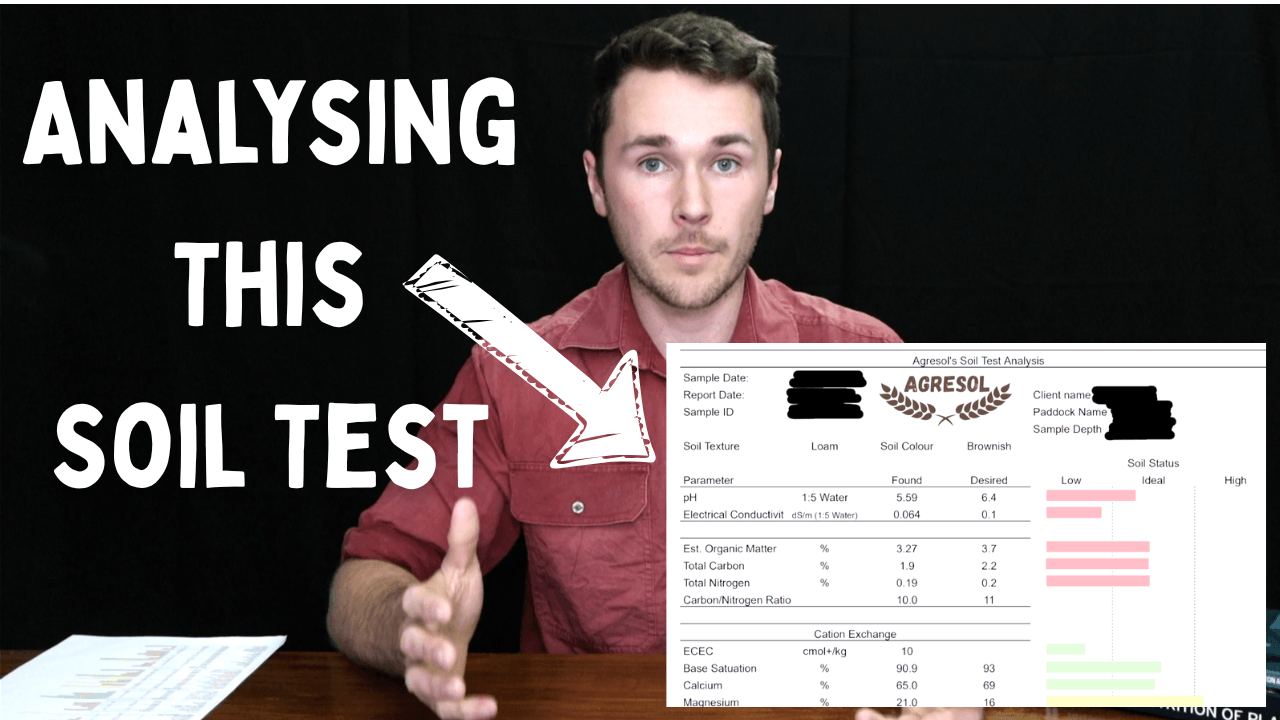
Recently, a young farmer reached out for guidance on turning around their 180-hectare family farm in coastal New South Wales. Facing challenges with traditional set stocking, declining pasture quality, and low financial returns, they needed a sustainable path forward. In this case study, we outline the exact financial strategy and tactical pasture solutions designed to rebuild soil health and significantly boost overall farm profitability.
First watch the video below from our Agresol Youtube channel.
Current Farm Background & Financial Diagnostic
The operation spans 180 hectares split into two main land types: 110 hectares of sandy flats and 70 hectares of rocky outcrop. Currently divided into 15 paddocks, the property is set stocked, with pasture dominated by African lovegrass and couch.
The primary goal of the young farmer taking over management is to generate a reliable, livable income from the farm.
Baseline Financial Performance
- Revenue: $80,200
- Total Assets: $2,400,000
- Asset Turnover Ratio: 3.4% (Industry benchmark target: ~15%)
- Gross Margin: 66.7%
- Overhead Ratio: 62%
- Return on Assets Managed (ROAM): 0.15% (Net profit of ~$3,500)
The key financial bottleneck is a severely restricted asset turnover ratio caused by low livestock yield and biomass production. While overhead percentage appears high, increasing overall revenue will dilute fixed overhead expenses automatically.
Overcoming Set Stocking & Restoring Pasture Productivity
Set stocking leads to selective overgrazing. Livestock continually consume the most palatable pasture species while ignoring poorer feed. Over time, desirable plant species die out, allowing dominant, low-productivity weeds like African lovegrass and couch to take over.
Implementing Adaptive Regenerative Grazing
To allow desirable species to recover, the farm must transition to an adaptive grazing system managed around plant recovery times:
- Growing Season Recovery: Target a 30-day recovery period. Across 15 paddocks, this equates to an average grazing duration of ~2.1 days per paddock.
- Non-Growing Season Recovery: Extend rest periods to 60 days or more based on pasture growth rates.
Managing African Lovegrass
When African lovegrass reaches Phase 3 maturity (lignified stage), its protein levels and digestibility plummet. Livestock can starve with full bellies because they cannot digest the mature fiber.
- Biomass Threshold: Keep African lovegrass below 3,000 kg dry matter (DM) per hectare to maintain palatability.
- Grazing Intensity: Apply short, heavy grazing pressure to prevent smothering of surrounding species and maintain open inter-plant space for new seed germination.
Pasture Improvement Strategies: Technical Comparison
To transition pasture composition toward higher-yielding species, two main approaches can be combined across the property:
Option A: High-Return Improved Pastures
- Implementation: Terminate low-value pasture with a targeted herbicide to ensure long-term perennial establishment (15+ years).
- Species Blend: Chicory, plantain, cocksfoot, phalaris, lucerne, and red/white clovers to provide representation across all key functional plant groups.
- Nutritional Inputs: Perform baseline soil testing, apply capital lime (if acidic/sandy), and incorporate starter fertilizers (MAP or guano with nitrogen).
- Economics: Estimated cost of $750–$1,000 per hectare. Amortized over 15 years, this represents $50–$100/ha/year. Payback period is 12 to 18 months with a ~100% rate of return. Total capital for 110 hectares of flats would be up to $110,000, which can be rolled out progressively paddock-by-paddock.
Option B: Ecological Succession & Trample Sowing
- Implementation: Utilize existing seed banks (e.g., native kangaroo grass or microlaena) combined with broad-scale cover cropping.
- Trample Sowing: Broadcast winter forage species (oats, vetch, field peas, radish) in May into senescing pastures. Follow immediately with high-density livestock grazing down to ~1,500 kg DM/ha to trample seed into direct soil contact.
- Benefits: Provides low-cost winter feed, increases root exudates, stimulates soil biology, and improves fertility cycles without heavy upfront capital.
Winter Nutritional Supplementation
During winter, as warm-season grasses naturally decline in quality, non-protein nitrogen (e.g., urea licks) can be provided under strict management guidelines. Urea feeds the rumen microbiome, enabling livestock to digest low-quality dry matter more efficiently and maintain weight gains through feed gaps.
Projected Financial Returns
With regenerative grazing and targeted pasture improvements driving yield up to ~8 tonnes DM/ha, performance metrics improve substantially:
- Projected Revenue: $233,000
- Asset Turnover Ratio: 8.7%
- Overhead Ratio: Significantly reduced via overhead dilution
- Return on Assets Managed (ROAM): 3.55% (Net profit of ~$95,700)
Achieving $95,700 in net profit fulfills the initial goal of providing a livable income while generating working capital to fund future soil health and pasture upgrades toward a 5% ROAM target ($120,000 profit).
Drought Preparedness & Destocking Protocol
When 12-month rolling rainfall drops (e.g., from 900mm down to 500mm), carrying capacity drops accordingly (e.g., from 1,000 down to 600 head). Feeding hay during dry periods is rarely profitable.
Action Plan for Feed Deficits:
- Conduct Pasture Budgets: Measure existing standing biomass to calculate days of feed remaining without rain.
- Cull Low Performers: Immediately sell the bottom 20% of unproductive, older, or genetically inferior stock to extend pasture reserves.
- Early Weaning: Wean calves early to reduce lactating cow energy demands and lower overall herd feed intake below carrying capacity.