When designing crop nutrition programs, two distinct models are typically taught: the law of diminishing returns and the law of minimums. While often learned in school or university, these two theories actually stand in direct conceptual contrast to one another. Understanding how to reconcile this conflict is essential for farmers trying to maximise their rate of return on fertiliser inputs.
First watch the video below from our Agresol Youtube channel.
The Conflict Between the Two Laws
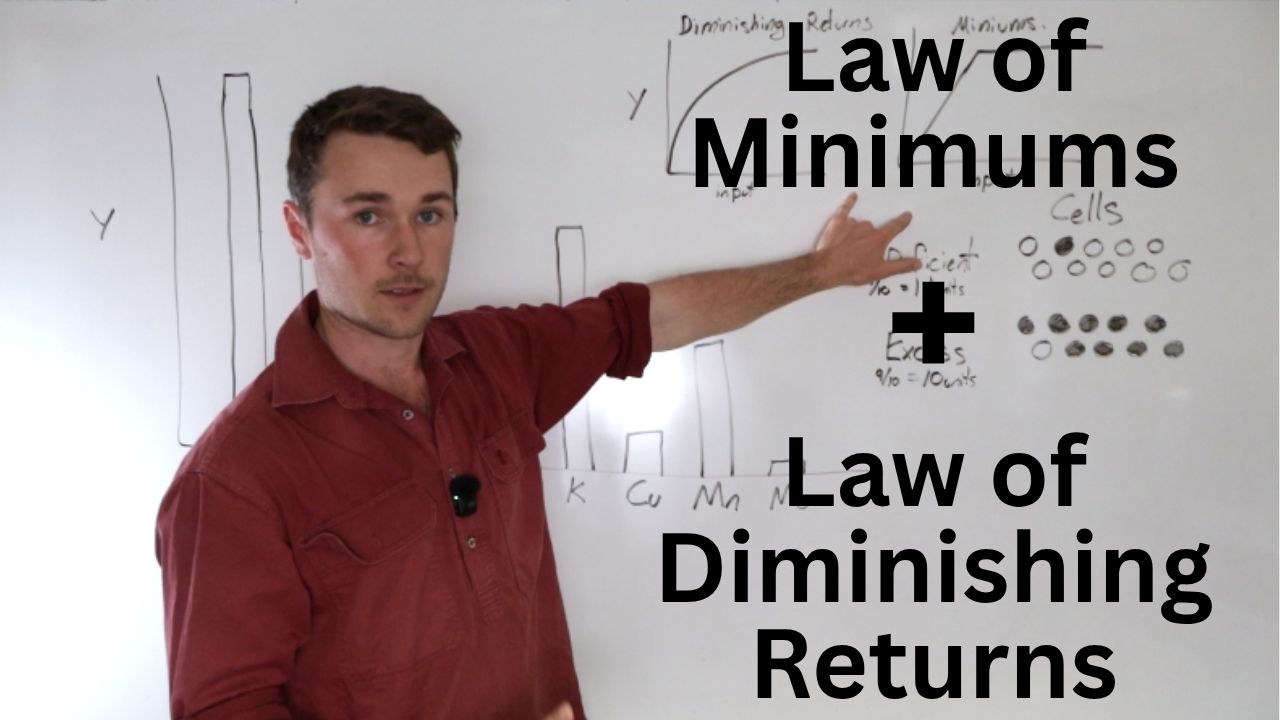
The law of diminishing returns suggests that as you increase the input of a specific nutrient, the return per additional unit decreases. For example, the first unit of nutrient might yield 10 units of crop response, but eventual additions may yield only 1 unit of response per unit of input. This produces a curved, sloping return across the system.
Conversely, the law of minimums states that a system is constrained by a single limiting factor at a time. Adding nutrition to fix that specific bottleneck yields a linear, consistent increase in production until the next bottleneck is reached.
Reconciling the Plant and the Cell
How do we use these contrasting models to guide on-farm nutrition decisions? A research paper titled “Reconciling the Mitscherlich’s law of diminishing returns with Liebig’s law of the minimum. Some results on crop modeling“ resolves the debate by separating the scale of application. The law of minimums operates at the individual cell level, while the law of diminishing returns operates across the entire plant or field.
Consider a nitrogen-deficient plant made up of 10 cells, where only 1 cell has sufficient nitrogen. When 1 unit of nitrogen is applied, it gets randomly allocated among the cells. Because 9 out of 10 cells are deficient, there is a 90% probability that the nutrient hits a deficient cell and creates a positive yield response. Statistically, supplying just 1.1 units of nitrogen will likely fill an empty cell.
However, if 9 out of 10 cells are already sufficient, a new unit of input has only a 10% chance of landing on that single deficient cell. It now takes 10 units of nitrogen to achieve the same expected probability of filling that final spot. The compounding probability across millions of cells creates the characteristic curve of diminishing returns.
The Hierarchy of Limiting Factors
Crop yield is dictated by a sequential hierarchy of constraints:
Genetic Potential: Sets the absolute theoretical upper limit of production, which is rarely fully reached in practice.
Climate: Regional factors like temperature and day length establish the real-world ceiling for yield in a given area.
Water: In dryland agriculture, water availability is often the primary unmanageable limiting factor that farmers work to maximize.
Nutrition: Once climate and water are accounted for, individual soil nutrients (among the 17+ essential elements) dictate the remaining yield capacity.
Finding Your Maximum Sustainable Output
Soil tests measure nutrient levels against “critical values”—the concentrations required to achieve 90% to 95% of maximum yield. Graphing these values highlights the most limiting nutrient.
If molybdenum is the most deficient element, overall yield is capped at the molybdenum limit. Applying molybdenum increases yield up to the level of the next limiting factor, such as copper. To keep increasing production, both molybdenum and copper must then be supplied until a third nutrient becomes the bottleneck.
However, raising every nutrient to its theoretical maximum is rarely cost-effective. As detailed in the book The Profitable Farm, pushing production when most nutrients are near optimal levels incurs exponential variable costs. Instead of attempting to hit maximum theoretical potential, farmers should target their Maximum Sustainable Output—the sweet spot where input costs do not exceed the monetary value of the yield increase.
Practical Steps for Farm Nutrition
When reviewing soil tests, prioritize the most limiting factor that shows the greatest deviation from ideal levels. Apply that element up to the threshold of the next limiting nutrient, and continue sequentially. If abundant reserves of non-limiting minerals like potassium exist in the soil, draw from those reserves rather than buying excess fertilizer. Once the cost of fixing the next set of minor deficiencies outweighs the financial return from the yield gain, you have reached your maximum sustainable output.