If you’re looking to unlock deeper insights into plant health and nutrition, differential sap testing is one of the most powerful tools available. Unlike traditional soil testing, sap testing offers real-time information about nutrient dynamics inside the plant—giving you the ability to make timely, targeted interventions.
In this article, we’ll walk you through exactly how to read a differential sap test report, interpret the data, and apply the results to improve yield, quality, and resilience in your farming system.
But first watch the video below from our YouTube Channel (and make sure to subscribe!)
Get A FREE Differential Sap Test Analysis!
What Is a Differential Sap Test?
A differential sap test compares the nutrient levels in a plant’s young and old leaves. By doing so, it shows how nutrients are moving—or failing to move—through the plant. This gives insight into nutrient deficiencies or excesses before visible symptoms appear.
The core principle is simple:
Mobile nutrients like nitrogen, magnesium, phosphorus, and potassium move from old to new leaves. A deficiency shows up as more of that nutrient in the young leaves.
Immobile nutrients like calcium, boron, and silica stay put. A deficiency appears as less of that nutrient in young leaves.
Rather than relying on fixed “ideal” numbers (which vary by crop and stage), we assess whether the plant is balanced internally.
Understanding the Report: Key Sections
1. Metadata (Top of Report)
Always check the basics:
Sample date
- Sample ID
Crop type
Location (paddock name)
Client name
Without this, you can’t track changes or make accurate decisions.
2. Plant Health Indicators
These values appear at the top of your report:
Sugar %: Reflects photosynthesis and energy movement in the plant. Low sugar = low photosynthetic activity = likely mineral deficiency.
pH: Helps diagnose nutrient imbalances and possible pest or disease risk. A high pH suggests missing anions like nitrate, sulfur, phosphorus or boron and increases pest pressure. A low pH suggests missing cations like calcium, potassium and magnesium and increases fungal disease pressure.
EC (Electrical Conductivity): Indicates the total level of minerals in the sap. High EC may point to excesses, while low EC may suggest poor nutrient uptake or root damage.
3. Nutrient Status & Leaf Age Comparison
Each nutrient shows:
Levels in young vs. old leaves
YO % (Young/Old Ratio) – the percentage difference
Visual bar graphs showing how far from balance the nutrient is
Status labels with slight moderate or severe deficencies or potential excesses.
This visual layout helps you spot your limiting factors quickly and prioritise action.
Key Takeaways from a Sample Report
Let’s say this is your sap test:
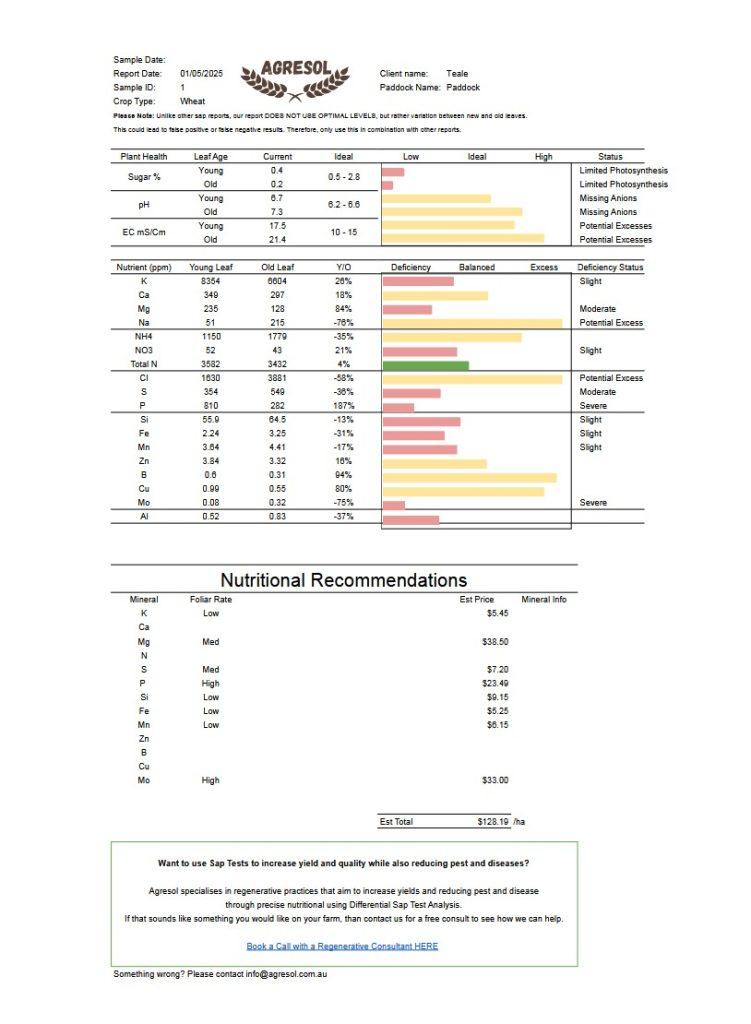
Magnesium deficiency (84% more in young than old leaves): Critical for chlorophyll and photosynthesis. This could be the main cause of low sugar production.
High sodium: Common in sodic soils. Sodium disrupts uptake of potassium, magnesium, and calcium—throwing the whole system out of balance.
Chloride excess: Can trigger phosphorus and sulfur deficiencies and even increase pest pressure when the chloride-to-nitrogen ratio exceeds 1:1.
Low silica: Reduces stress tolerance. A foliar application or soil-based source like soft rock phosphate can help.
Micronutrients (iron, manganese, molybdenum): Often overlooked, but crucial for photosynthesis and nitrate conversion.
Together, these imbalances suggest poor photosynthetic capacity and pest susceptibility—issues that can be corrected early with the right nutritional strategy.
Foliar Nutrition: Fixing Deficiencies Fast
One of the big advantages of sap testing is that it helps guide foliar nutrition. When soil-based uptake is blocked (e.g. due to sodicity or salinity), foliar sprays bypass the soil and deliver nutrients directly to the plant.
Your report may include a basic recommendation table, offering low, medium, or high foliar rates for nutrients flagged as deficient. While helpful, these are generalised. For a more tailored strategy, professional interpretation is advised.
Why Differential Sap Tests Work Across All Crops
Because they rely on relative differences between leaf ages—not crop-specific optimal levels—differential sap tests can be used for any crop at any stage. The interpretation hinges on understanding nutrient mobility and plant physiology rather than arbitrary targets.
Final Thoughts
Differential sap testing offers a smarter, more dynamic view of plant nutrition. It helps you:
Anticipate deficiencies before symptoms appear
Optimise foliar nutrition
Reduce pest pressure through balanced nutrition
Make confident, data-backed decisions