n the regenerative agriculture space, you frequently hear the advice: “Focus on profit, not yield”. While prioritizing financial health over raw production is understandable , framing the choice as “profit versus yield” creates a false binary. It implies you must choose one or the other.
In reality, yield is an indispensable component of the profit equation. If your yield drops toward zero, your net profit inevitably moves toward zero as well. To build a resilient farming business, you cannot simply ignore production, the true goal is maximizing yield while minimising direct costs per unit.
First watch the video below from our Agresol Youtube channel.
The Profit Equation: Four Levers of Farm Economics
To make sound financial decisions, we must break down how profit is calculated on a farm:
This formula reveals four distinct levers that dictate profitability:
Yield (Units Produced): Total metric tons, dry matter, DSE, or kilograms harvested per hectare.
Price per Unit: Gross revenue received per unit sold (e.g., $350/t for wheat or $4/kg for livestock).
Direct Costs per Unit: Variable expenses directly tied to production, such as fertilizer, seeds, chemical sprays, and irrigation.
Overheads: Fixed operational costs that must be paid regardless of crop output, including land rates, insurance, and permanent labor.
Controlling the Levers
Price per Unit is largely fixed for commodity producers. Industry benchmarking consistently shows that top-tier and underperforming farmers generally receive similar commodity prices. Unless you market direct-to-consumer, price is usually the hardest lever to move.
Overheads are fixed baseline costs that exist whether you harvest a record yield or nothing at all.
The Danger of Input Slashing
A common pitfall during a regenerative transition is drastically cutting inputs without safeguarding yield. Consider two management scenarios on land valued at $10,000/ha:
System A: High Yield, Standard Inputs
Yield: 4 t/ha
Price per Ton: $300/t
Direct Costs: $150/t (50% gross margin)
Gross Profit: 4t x $150/t = $600/ha
Overheads: $210/ha
Net Profit: $390/ha
Return on Asset (Land): 3.9%
System B: Halved Inputs, Halved Yield
Yield: 2t/ha
Price per Ton: $300/t
Direct Costs: $75/t (75% gross margin)
Gross Profit: 2t X $225/t = $450/ha
Overheads: $210/ha (unchanged fixed overheads)
Net Profit: $240/ha
Return on Asset (Land): 2.4%
By cutting direct input costs at the expense of yield, System B became 62.5% less profitable than System A. Because overheads remained fixed , the lower yield failed to generate enough gross margin to service the land asset efficiently.
Understanding the Marginal Rate of Return
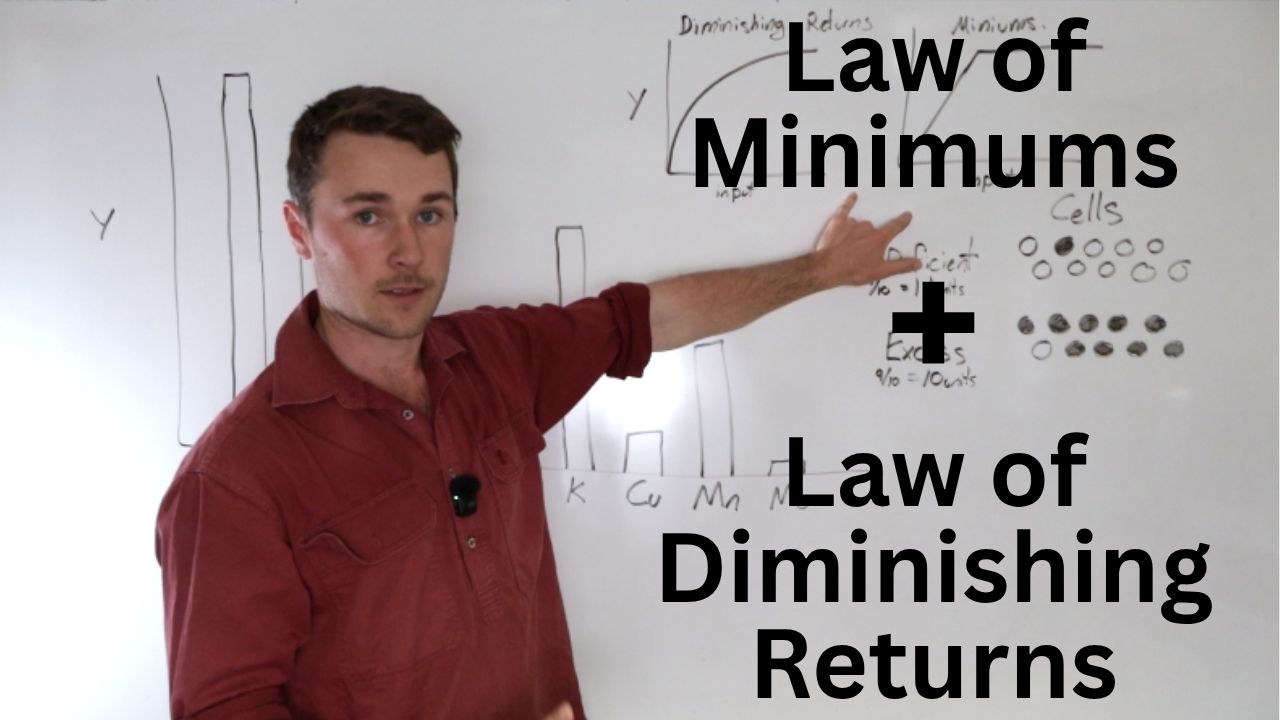
When evaluating crop inputs, especially nutrition, we must evaluate the Marginal Rate of Return. Every dollar spent on an input should yield more than one dollar in return.
High-Return Zone: Initial input applications address critical limiting factors, yielding high profit margins (e.g., spending $1 to gain $20 return is a good deal).
Diminishing Returns Zone: As applications increase, return per dollar spent decreases.
Negative/Toxic Zone: Over-application costs more than the yield benefit gained, or causes plant toxicity that destroys yield.
Furthermore, strategic inputs like nitrogen fuel plant biomass growth. Larger plants and root systems pump carbon exudates into the soil, feeding biology and building organic matter.
The Winning Strategy: Maintain Yield, Reduce Cost per Unit
The goal of regenerative agriculture is not to sacrifice yield to save on inputs. The core objective is maintaining target yields while systematically lowering direct costs per unit.
Practical strategies to lower cost per unit without sacrificing yield include:
Foliar Nitrogen: Applying lower doses of targeted foliar N for higher plant absorption efficiency.
Biological N-Fixing Bacteria: Inoculating crops to unlock atmospheric nitrogen.
Legume Rotations: Integrating nitrogen-fixing legumes into cash crop cycles.
Humic Substances: Combining inputs with humates to increase nutrient availability and prevent leaching.