In regenerative agriculture, we often focus on providing the “right” amount of nutrients, but plant health is rarely just about quantity. The true secret to healthy crops lies in understanding nutrient interactions, the complex ways that one mineral can either help or hinder the uptake of another.
We find that the most common reason for a nutrient deficiency isn’t a lack of that mineral in the soil, but rather an excess of a competing nutrient. When one mineral dominates the plant sap, it can suppress other minerals, creating a bottleneck that reduces yield and invites pests and diseases.
The Law of the Minimum
We often talk about the Law of the Minimum, which states that yield is limited by the single most deficient factor. However, in a regenerative system, we must also consider the “inverse”: an excess of a nutrient can become that limiting factor by suppressing other essential minerals.
Types of Interactions:
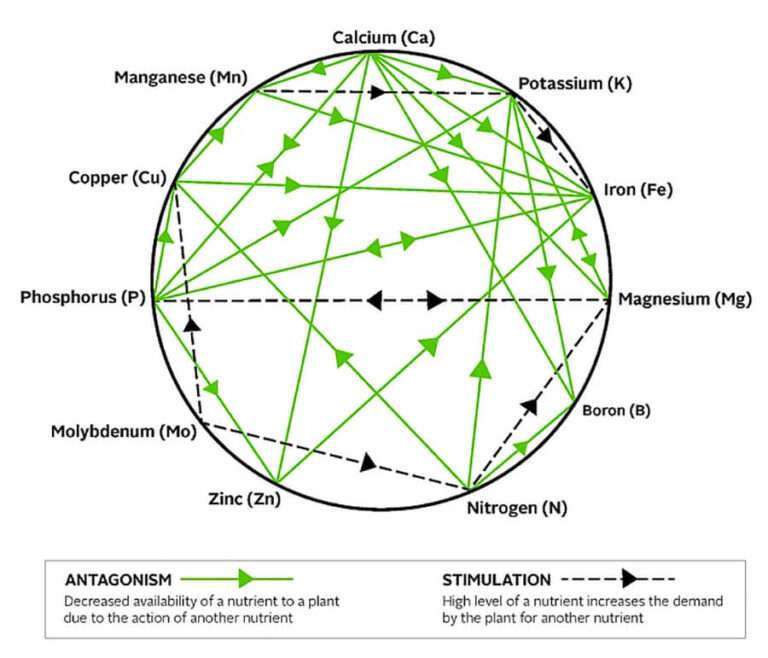
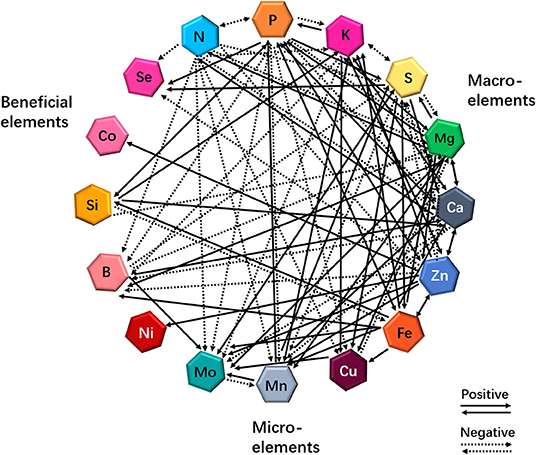
Antagonistic: A “positive-negative” relationship where the excess of one nutrient prevents the uptake of another (e.g., too much sodium blocking calcium).
Synergistic: A “positive-positive” relationship where the presence of one nutrient actively assists the plant in absorbing or using another.
These interactions can be seen in the mulder’s chart (left) and on a more comprehensive chart (right)
The Four Quadrants of Antagonism
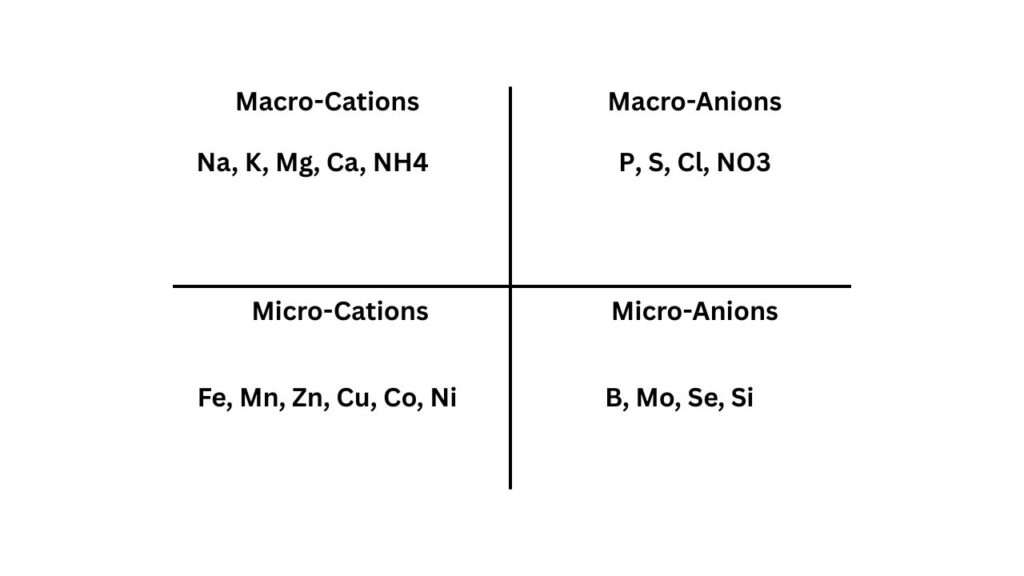
To simplify these complex interactions, we categorize nutrients into four main quadrants. As a general rule, an excess of any mineral in a quadrant will suppress the other minerals within that same group.
Macro-Cations: Sodium, Potassium, Magnesium, Calcium, Ammonium
Macro-Anions: Phosphorus, Sulfur, Chloride, Nitrate
Micro-Cations: Iron, Manganese, Zinc, Copper, Cobalt, Nickel
Micro-Anions: Boron, Molybdenum, Selenium, Silica
Key Synergies and Regulators
Some nutrients work as “co-factors” or regulators, meaning they are required for the other to function correctly:
Calcium and Boron: These two are the ultimate partners; you generally need both present for either to be absorbed effectively.
Potassium and Manganese: These are critical co-factors for mutual uptake and internal plant movement.
Molybdenum and Nitrogen: In order to convert Nitrate into a usable form (Ammonium), the plant must have Molybdenum to power the nitrate reductase enzyme.
Phosphorus and Zinc: These often act as mutual regulators to keep each other from reaching toxic or deficient levels.
Balancing Nutrition With Biology
While foliar applications can provide a “band-aid” fix for nutrient imbalances, the long-term regenerative goal is to outsource this work to soil biology.
Biological systems are far better at balancing nutrition than a human with a fertilizer spreader. We focus on two primary biological pathways:
Mycorrhizal Fungi: These fungi act as extended root systems, scavenging for exactly what the plant needs and bringing it back in a balanced form.
The Rhizophagy Cycle: This process, where plants “consume” microbes, can provide a significant portion of a crop’s balanced nitrogen and mineral needs.
Summary
Managing plant health is about more than just checking boxes on a soil test; it’s about managing the relationships between minerals. By reducing excesses and stimulating soil biology, you can create a self-regulating system that maximizes yield and resilience.
If you want to move beyond basic soil tests and start managing the critical nutrient interactions on your farm, then sign up for a free 30-minute consultation.