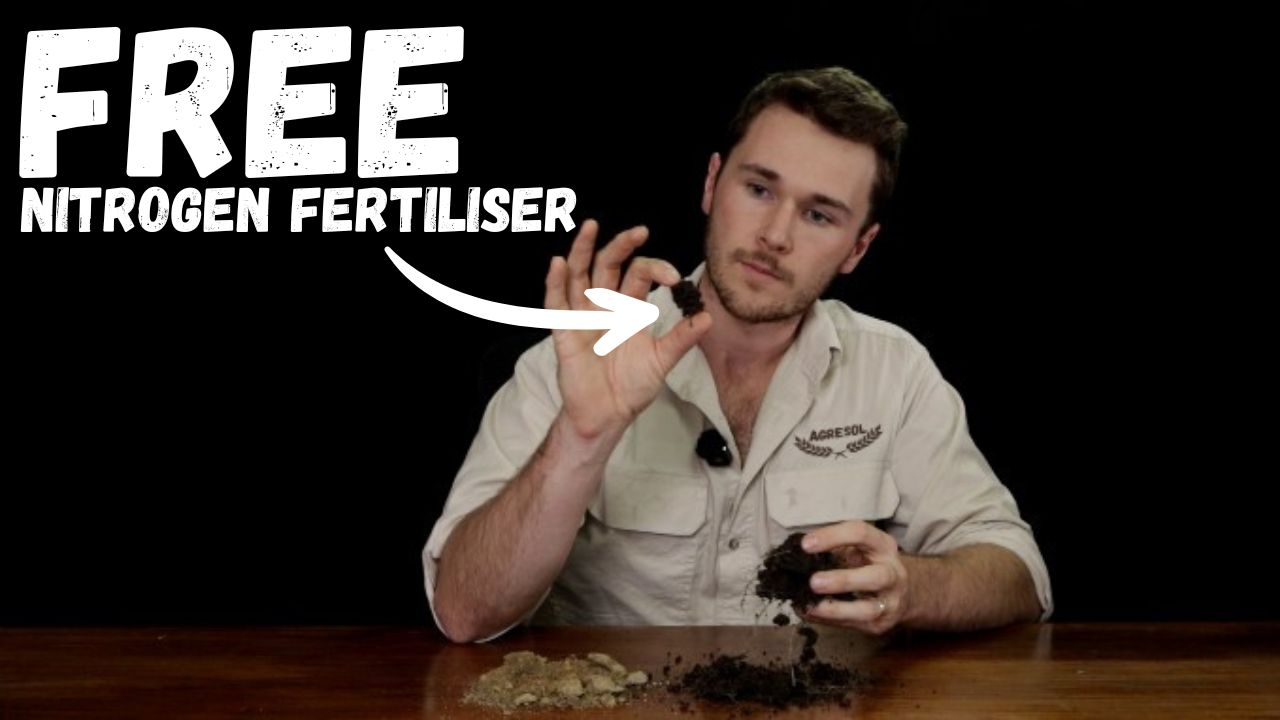
With urea prices soaring, every farmer is looking for a way to cut costs without sacrificing yield. While we often think of legumes as the go-to for nitrogen fixation, there is a hidden army of free-living microbes right in your soil that can produce nitrogen fertiliser for free.
At Agresol, we focus on maximizing these biological systems to boost your profitability. Here is how you can turn your soil into a nitrogen-producing factory.
The Tale of Two Soils
Two soils can come from the same parent sandstone material but perform completely differently.
The “Dead” Soil: Bare, capped on top, and lacking oxygen. It has no structure, meaning the microbes can’t breathe or work.
The “Regen” Soil: Covered, dark with soil organic carbon, and full of earthworms. Most importantly, it has aggregation, clumps of soil that create the perfect habitat for nitrogen fixation.
The Science of Free Nitrogen
The atmosphere above every hectare of your farm contains roughly 80,000 tons of nitrogen gas. The problem is that it’s held together by a triple bond, making it “glued” together and unusable for plants.
Microbes like Azotobacter use a special enzyme called nitrogenase to break these bonds and convert nitrogen gas into ammonia (NH3), which the plant then uses to build amino acids and proteins.
5 Factors to Maximize Your Nitrogen Factory
If you want to maximize this enzyme and get free nitrogen, you need to manage these five factors:
1. Microbe Presence
You likely have some of these microbes already, but diversity is key. The most cost-effective inoculant is worm casting extract. Applying just 5 liters per ton of seed costs about $1 per hectare and provides a massive range of nitrogen-fixing bacteria.
2. The Right Environment
Microbes need water, stable temperatures, and specific oxygen conditions.
Gas Exchange: Soil needs to breathe so nitrogen and oxygen can move through the profile.
Reduced Pockets: Ironically, the nitrogenase enzyme needs a low-oxygen environment to function. Good soil aggregation acts like a “nodule,” providing the low-oxygen space inside the aggregate while allowing gas exchange outside it.
3. Energy (Root Exudates)
Fixing nitrogen is incredibly energy-intensive for a microbe. They get this energy from root exudates, carbohydrates and lipids pumped into the soil by the plant. You can boost this by maximizing photosynthesis; aim for a Brix level of 12+ using foliar applications of minerals like magnesium, iron, and manganese.
4. Critical Minerals: Molybdenum and Cobalt
The nitrogenase enzyme itself is made of Molybdenum (Mo) and Iron. In many Australian soils, Molybdenum is deficient. Additionally, Cobalt is required to produce Vitamin B12, which the microbes need to fix nitrogen.
Note: Always take a soil test before applying these, as they can be toxic in high concentrations.
5. Keep Mineral Nitrogen Low
The process stops if there is too much mineral nitrogen (above 20 parts per million) already in the soil. If you apply too much synthetic fertilizer, the microbes simply stop working.
The Payoff: What’s it Worth?
Under ideal conditions, free-living microbes can produce up to 2.3 kg of nitrogen per day. Over a 30-day peak period, that’s 60 kg of nitrogen per hectare, all without a single bag of urea. However this could be more if the above is applied.
By improving your soil’s gas exchange and biological activity, you aren’t just saving money; you’re building a resilient system that works for you.