We understand that for a commercial grower, the greatest risk in transitioning to regenerative agriculture is the potential for a “yield dip”. Many farmers hear success stories of others cutting inputs entirely and try to follow suit, only to see their production plummet because the underlying soil system wasn’t ready to support the crop.
The solution is a framework we call the Biological Supply Curve. This approach allows you to strategically reduce synthetic inputs while maintaining or even improving your yields by focusing on the biological capacity of your soil.
First, watch the video below from our Youtube channel Agresol (and make sure to subscribe!)
The Fundamental Rule of Nutrition
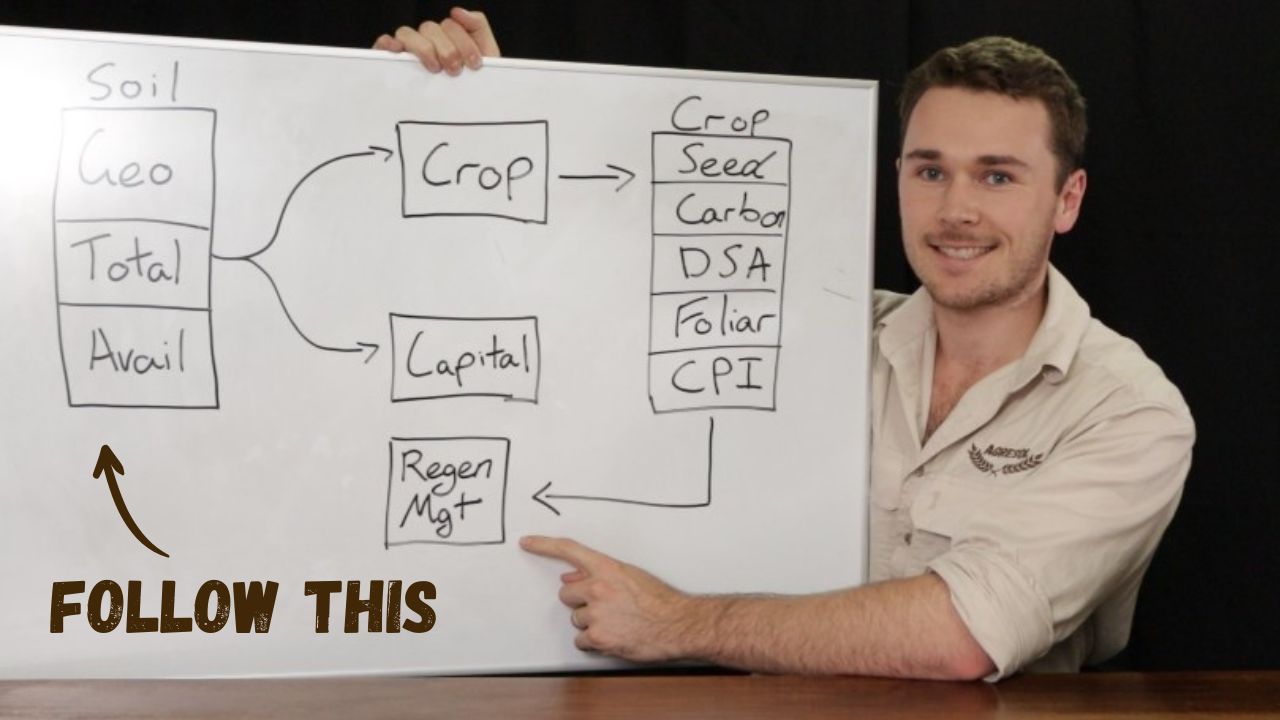
Regardless of whether you are in a conventional or regenerative system, your plants have a fixed nutritional requirement to reach a certain yield. For example, a ton of wheat physically contains and requires approximately 23 kilos of nitrogen and 3 kilos of phosphorus.
The only thing that changes in a regenerative system is how those nutrients are supplied. You can either buy them in a bag (fertilizer) or outsource that work to soil biology that extracts minerals from the parent material and fixes nitrogen from the atmosphere.
Understanding the Biological Supply Curve
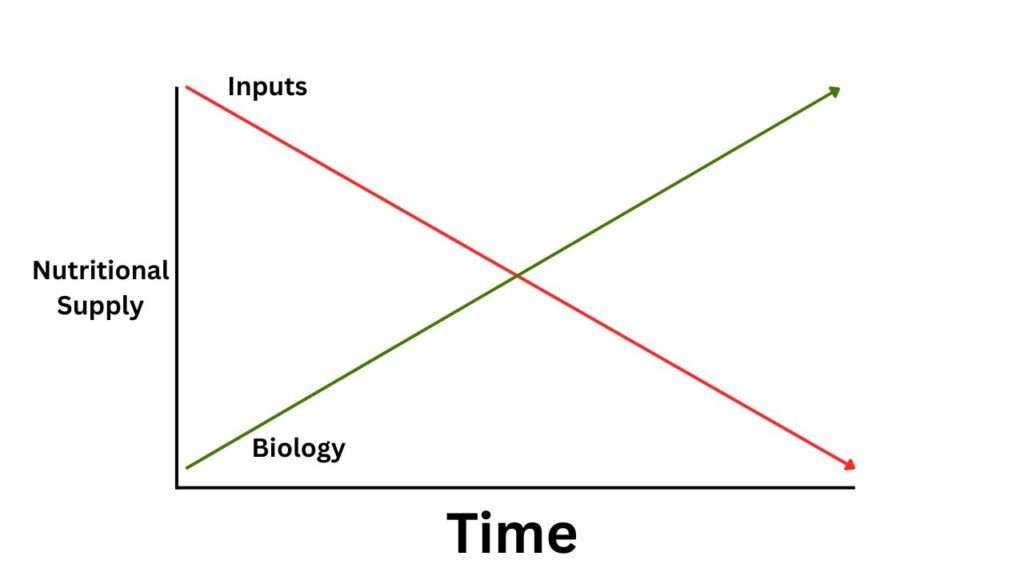
At the start of a transition, most conventional systems rely on synthetic inputs for nearly 100% of the added crop requirement, while the biological supply is often minimal. The end goal is to flip this relationship: increasing the biological supply so that you can reactively decrease your synthetic inputs to a lower rate.
The Error of “Cold Turkey” Cuts: Farmers often cut their nutrition first and expect the biology to instantly fill the gap. If the biology hasn’t been built up, the system cannot meet the crop’s needs, and yield is lost.
The Agresol Strategy: We focus on pushing the “Biological Supply” line upward first. Once soil tests and sap tests prove the system is providing more nutrition, we then cut input rates in response.
The ROOTS Framework for Transition
We use the ROOTS framework to guide this strategic reduction of inputs at every stage of the transition:
Reframe – Committing to a biological approach rather than a purely chemical one.
Optimise – Improving the efficiency of inputs to reduce lose, such as adding humic substances, foliar applications, use of trace minerals, split applications, etc.
Outsource – Moving to more biologically friendly inputs like guano that are easier on soil microbes.
Transform – Changing our farming system to allow the system to supply more nutriton. For example, increasing diversity, no-till, intercropping, polycultures, livestock intergration.
Steward – Finding the optimal low-input “maintenance rate” that maximizes yield for your specific climate.
Building the System
While the goal is to reduce costs, we stay grounded in the economic reality that land is expensive and you must maximize your return on investment. Building the biological line involves several key practices:
Biological Inoculants: Treating seeds to kickstart microbial colonization.
Increasing Brix: Improving photosynthesis to pump more carbon (sugars) into the soil to feed microbes.
Integration: Utilizing soil primers, cover crops, and livestock to accelerate nutrient cycling.
Summary
The Biological Supply Curve is about building the biological component before cutting inputs. We maintain the necessary inputs to fill the “gap” between what the soil can currently provide and what the crop needs for a profitable yield. As that gap shrinks, so does your fertilizer bill.
If you are ready to stop guessing and start strategically increasing the biological supply of nutrients to your plants, then sign up for a free 30-minute consultation with Agresol. We’ll go over five practical ways you can start implementing these ideas on your farm today.