Legume Nitrogen Fixation is a powerful tool in any regenerative farming system, thanks to a legumes ability to fix atmospheric nitrogen and reduce reliance on synthetic fertilisers. But what happens when your legumes aren’t forming nodules at all? If you’re pulling up your legume crops and finding no nodules, or poor nodulation, you’re missing out on free nitrogen — one of the main reasons for planting legumes in the first place.
In this article, we’ll cover:
How nitrogen fixation works in legumes
How to assess your legumes’ nodulation
Why your legumes might not be fixing nitrogen
How to correct the problem using soil and crop management
But first make sure to watch this video from our YouTube Channel (and more sure to subscribe!)
How Legumes Fix Nitrogen
Nitrogen makes up around 78% of our atmosphere, which is about 7400 tonnes of N/ha! Yet many soils are still nitrogen deficient. Legumes, with the help of Rhizobia bacteria, can tap into this massive resource. Here’s how the process works:
Legume roots exude signals into the soil.
Rhizobia bacteria, specific to the legume species, respond and colonise the root zone.
The root curls around the bacteria, forming a nodule.
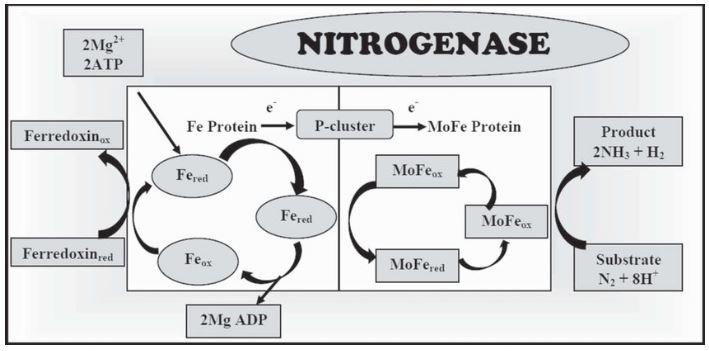
Inside the nodule, Rhizobia convert atmospheric nitrogen (N₂) into ammonia (NH₃) using energy (ATP) supplied by the plant.
The plant then converts this ammonia into amino acids to fuel growth.
This process is energy-intensive (requiring around 16 ATP molecules per nitrogen molecule), but the payoff is huge — well-functioning legumes can fix up to 200–300 kg of nitrogen per hectare.
This can mean that for a legume crop such as chickpeas, lentils, Soybeans etc, nitrogen fertiliser does not need to be applied because the crop produces its own nitrogen AND this remaining nitrogen in the left over plant residue can contribute to the following crop’s nitrogen source. Additionally, adding these species to a cover crop or green manure crop can produce nitrogen for the following crop, meaning spending less on nitrogen fertiliser while getting many soiol health benefits!
How to Assess Nodulation in the Field
Before getting too excited about free nitrogen fertiliser, it is important to know that simply having a legume present does NOT mean you are fixing nitrogen. Legumes need to have active nodules full of Rhizobia bacteria to fix nitrogen, so this is how to check legume nodulation:
When checking your legumes, dig them up carefully and wash the roots in a bucket of water to avoid damaging any nodules. Then, assess them based on:
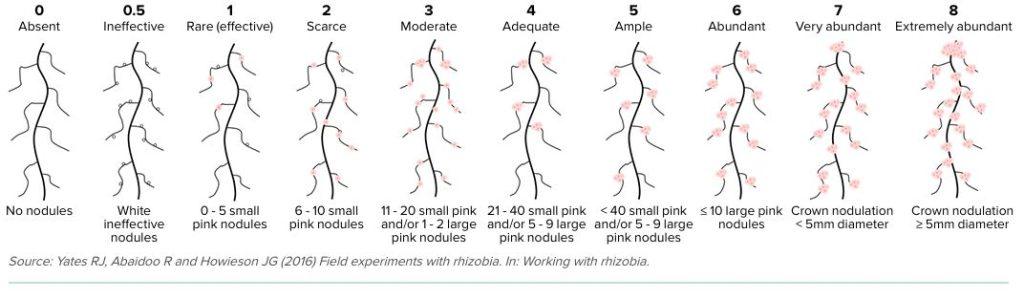
Nodule presence and distribution – Are nodules forming? Are they distributed throughout the root zone?
Nodule size – Larger nodules (>0.5 cm) indicate high nitrogen fixation.
Nodule colour – Cut open a few nodules. A red or pink interior indicates active nitrogen fixation due to the presence of leghemoglobin, a protein similar to haemoglobin in our blood.
To help score your nodulation, here is a chart from an MLA article (You can find it here) about legume nitrogen fixation.
Common Nodulation Problems and Their Causes
No Nodules?
If no nodules are present, the most likely reasons are:
Lack of Rhizobia: This can happen if legumes haven’t been grown in the paddock for years or if the seed wasn’t properly inoculated with the correct Rhizobia strain.
Excess Soil Nitrogen: High nitrogen availability in the soil (especially from synthetic fertilisers) signals to the plant that nodulation isn’t necessary.
Solution:
Introduce or reintroduce specific Rhizobia through inoculation, and manage nitrogen levels by growing scavenger species such as grasses or radishes that absorb excess soil nitrogen prior to sowing legumes.
Green, White or Brown Nodules?
These indicate the presence of nodules, but no active nitrogen fixation. Causes include:
Incorrect Rhizobia strain
Lack of iron, which is needed to produce leghemoglobin
Other micronutrient deficiencies affecting root or microbial function
Solution:
Ensure the correct Rhizobia inoculant is used for your legume species. Conduct a soil test to check for key trace elements, particularly iron, molybdenum, and cobalt, all critical for the nitrogenase enzyme to function.
Small Red Nodules Only at Root Tips?
This is a good sign, but limited nodulation may mean:
Poor root zone distribution
Compacted soil or poor gas exchange in deeper layers
Limited microbial habitat in the subsoil
Solution:
Focus on improving soil structure and aeration. Practices such as deep-rooted cover crops, reduced tillage, organic matter additions and liming can enhance oxygen availability and microbial activity.
Ideal Nodulation
This looks like:
Large nodules (>0.5 cm)
Even distribution across the root system
Red/pink interiors
Congratulations — your legumes are actively fixing nitrogen and your soil biology is thriving!
Essential Minerals for Legume Nitrogen Fixation
For legumes to effectively fix nitrogen from the atmosphere, a range of key minerals must be present in the soil. These minerals support the formation of nodules, enable the symbiotic relationship between the plant and Rhizobium bacteria, and facilitate the biochemical processes required for nitrogen fixation.
If you want to learn more about each mineral indepth, you can find a paper about each mineral HERE
Here’s a breakdown of the essential minerals and their roles:
1. Molybdenum (Mo)
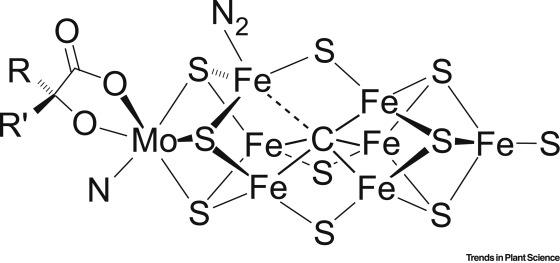
Role: Critical for the function of the enzyme nitrogenase, which is responsible for converting atmospheric nitrogen (N₂) into ammonia (NH₃). You can see the structure of nitrogenase below which contains Molybdenum.
Deficiency Impact: Without molybdenum, the nitrogenase enzyme cannot function, effectively halting nitrogen fixation.
2. Iron (Fe)
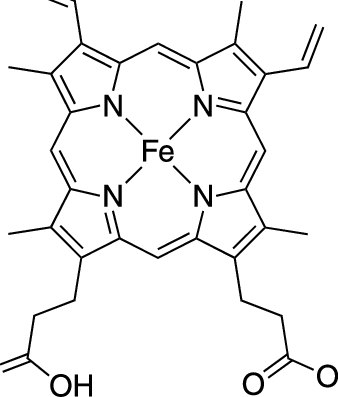
Role: Required for the synthesis of leghemoglobin which contains structures in the heme group (below-left), a protein that regulates oxygen within the nodule to protect the nitrogenase enzyme from oxygen damage. Likewise Iron is required in nitrogenase as seen above.
Deficiency Impact: A lack of iron can result in nodules that are green, white, or brown rather than the healthy red, indicating poor or no nitrogen fixation.
3. Phosphorus (P)
Role: Essential for energy transfer in plants; it supports the production of ATP (adenosine triphosphate), which fuels the nitrogen fixation process.
Deficiency Impact: Inadequate phosphorus limits the plant’s ability to supply energy to the Rhizobium bacteria, reducing fixation efficiency.
4. Cobalt (Co)
Role: Important for Rhizobium bacteria health and nitrogen fixation in some legume species. Cobalt is required in the synthesis of methyl malonyl-CoA mutase which is required in leghemoglobin production.
Deficiency Impact: Low cobalt can reduce bacterial activity and nodulation by reducing leghemoglobin production.
5. Calcium (Ca)
Role: Supports nodule formation and stabilises cell membranes during the infection process by Rhizobium. Calcium can also be important for floculating the soil particles to improve gas exchange into the soil.
Deficiency Impact: Poor calcium availability can impair nodule development and function.
6. Sulphur (S)
Role: Necessary for protein synthesis and the formation of essential amino acids after nitrogen is fixed.
Deficiency Impact: Limits the plant’s ability to use fixed nitrogen effectively.
7. Magnesium (Mg)
- Role: Central element in chlorophyll and required for Mg ATP hydrolysis.
- Deficiency Impact: Can reduce photosynthesis, limiting carbohydrate supply to the nodules and therefore restricting nitrogen fixation.
8. Potassium (K) and Boron (B)
Role: Supports sugar transport to nodules for rhizobia energy supply.
Deficiency effect: Limits nitrogenase activity and nodule efficiency due to energy and water stress.
10. Zinc (Zn) and Copper (Cu)
Role: Required in Cu–Zn superoxide dismutase which reduces free radicals within nodules.
Deficiency effect: increases oxidative damage in nodules.
How To Fix Deficiencies?
For these mineral defencies, get a complete soil test with totals and a sap test. The soil test will tell you what is available in the soil and the sap test will tells you exactly what the plant absorbing. The combination will help design a nutrition program using a mix of soil applied nutrition or foliar.
Final Tips for Optimising Legume Nitrogen Fixation
Always inoculate seed if there’s any doubt about Rhizobia presence in the soil.
Use multi-species cover crops or companion crops to manage excess nitrogen and build a healthier root zone.
Avoid applying high levels of synthetic nitrogen before or during legume growth.
Support soil microbes with organic inputs and living roots year-round.
- Supply required minerals for legume nitrogen fixation.